The End of the 'Toggle Tax': Why Unified Data Fabrics are the Secret to Underwriting Velocity
The Invisible Friction: The “Swivel Chair” Workflow
If you ask a mortgage underwriter where their day goes, they won’t tell you they spend eight hours analyzing credit risk. Instead, they’ll tell you about the “swivel.”
They swivel from the Loan Origination System (LOS) to a PDF viewer to read a bank statement. They swivel to a spreadsheet to calculate income. They swivel to a third-party OCR tool to check if the documents were indexed correctly. They swivel to a web browser to check GSE guidelines.
Each “swivel” is more than just a change of windows; it’s a cognitive break. In the world of enterprise productivity, this is known as the Toggle Tax. Studies suggest that it can take up to 23 minutes to fully regain focus after a context switch. In mortgage operations, where a single loan file can require hundreds of these switches, the cumulative impact is devastating. It is the primary reason why, despite billions of dollars invested in “digital” tools, the time to manufacture a loan has remained stubbornly high.
At Loancrate, we believe the solution isn’t another point solution or a better “plugin.” The solution is a fundamental architectural shift: moving from fragmented digital filing cabinets to a Unified Data Fabric.
Defining the Toggle Tax in Mortgage Ops
The Toggle Tax is the operational cost of fragmented data. In a legacy environment, the LOS is a passive recipient of information. It stores a field called “Monthly Income,” but it doesn’t “know” where that number came from. The proof of that income lives in a separate PDF, and the calculation logic lives in an underwriter’s head or a static Excel template.
This fragmentation forces the human to act as the “integration layer.” The underwriter must:
- Extract data from the document.
- Translate that data into the LOS format.
- Validate that the extraction matches the source.
- Reconcile that data against other documents (e.g., matching a deposit on a bank statement to a gift letter).
As we explored in our look at 10 manual tasks killing productivity, this “stare and compare” work is where velocity goes to die. It creates an operational ceiling that makes scaling without headcount impossible.
Why Legacy LOS Platforms Can’t Fix the Tax
Most legacy LOS platforms were built in an era of relational databases and static forms. They were designed to store results, not to manage the process of data creation. To solve the productivity gap, these platforms have historically relied on “bolt-on” integrations—OCR providers, automated underwriting systems (AUS) wrappers, and third-party verification services.
But these bolt-ons often increase the Toggle Tax. An underwriter now has to manage the LOS plus the OCR dashboard plus the verification portal. Data flows in one direction, often getting “stuck” or losing its lineage along the way. If a character is misread by an OCR tool, the underwriter must manually find the error, fix it in the LOS, and hope the change doesn’t break a downstream rule.
This is the heart of the mortgage tech debt crisis. You are layering new technology on top of a broken foundation, which only adds to the complexity.
Enter the Unified Data Fabric
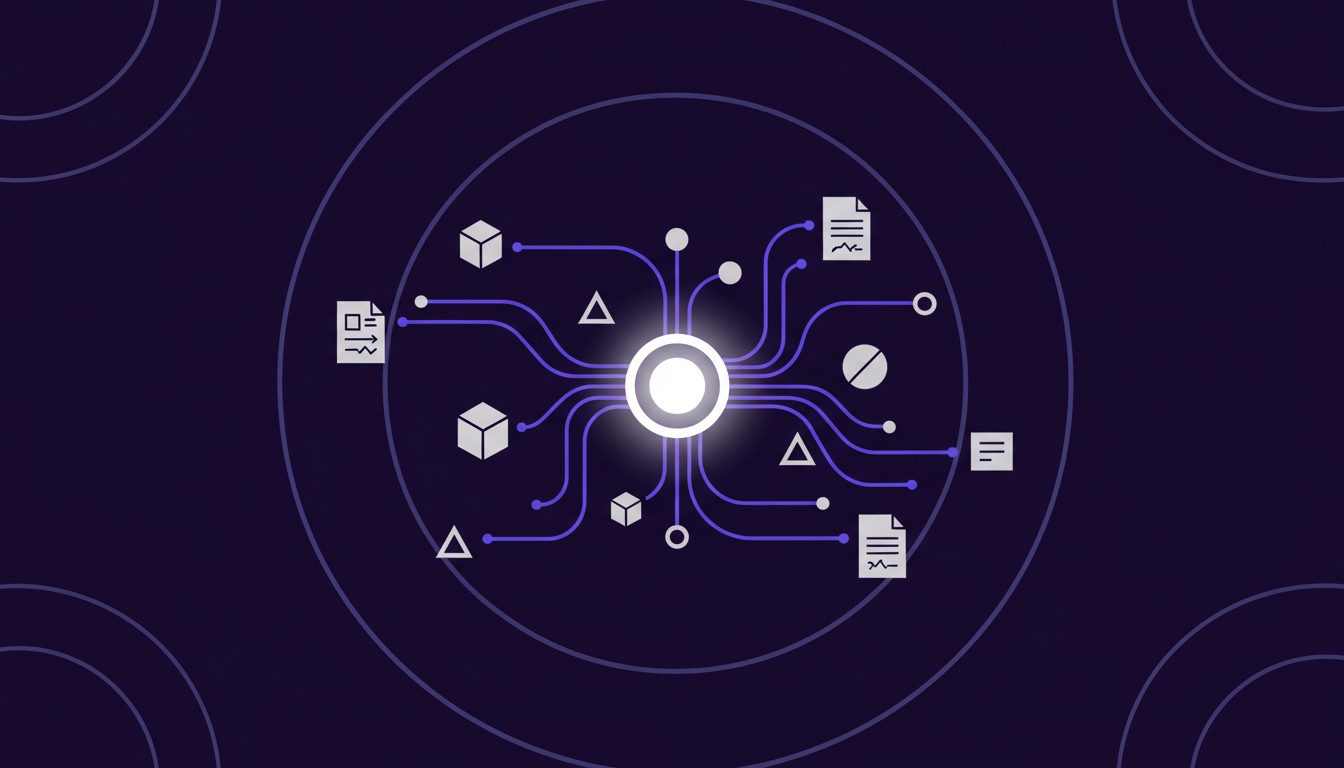
A Unified Data Fabric is an architectural approach that treats all loan information—documents, data fields, calculations, and rules—as a single, interconnected entity.
In an AI-native LOS like Loancrate, there is no “swivel.” When a document is uploaded, it isn’t just “stored.” It is semantically parsed. The system understands the relationships between the data points. A paystub isn’t just a PDF; it’s a collection of data entities (YTD earnings, employer name, tax withholdings) that are instantly mapped to the loan’s data model.
This fabric provides three critical advantages that eliminate the Toggle Tax:
1. Instant Cross-Document Validation
In a traditional workflow, an underwriter might spend 20 minutes cross-referencing a bank statement against a 1003 to verify a down payment source. In a Unified Data Fabric, the system performs this “semantic reconciliation” automatically. It identifies the $10,000 deposit on the statement, links it to the Gift Letter in the folder, and flags the relationship for the underwriter. The “toggle” is replaced by a single, verified notification.
2. Living Data Lineage
One of the biggest drivers of the Toggle Tax is the “Trust Gap.” Underwriters often re-do work because they don’t trust the automated output. “Did the OCR catch the bonus income?” “Is this calculation based on the most recent paystub?”
With a Unified Data Fabric, data carries its lineage with it. When an underwriter clicks on a qualifying income field, they don’t just see a number; they see the specific lines on the specific documents used to calculate it. This transparency builds the trust necessary for automated underwriting, allowing teams to shift to exception-based workflows.
3. Real-Time Pipeline Impact
In a fragmented system, a change in one data point (like a updated insurance premium) requires a manual cascade of updates. The underwriter must re-calculate the DTI, re-run the compliance check, and potentially re-submit to the AUS.
In a Unified Data Fabric, the system is reactive. A change to the insurance premium ripples through the entire loan model instantly. The DTI is updated, TRID tolerances are checked, and the continuous compliance engine verifies that the loan is still within guidelines—all without the underwriter ever leaving the screen.
From “Swivel Chair” to “Command Center”
When you eliminate the Toggle Tax, the role of the underwriter evolves. They move from being a data entry and verification clerk to being a “Loan Orchestrator.”
Instead of spending hours on AI-driven income calculation for simple W-2 files, they focus their expertise on the complex 20% of files that truly require human judgment—self-employed borrowers with multiple LLCs or unique property types.
This shift is enabled by agentic AI in mortgage operations. These agents live within the data fabric, performing the mundane “swivel” tasks on behalf of the human. They gather the data, perform the “First Pass” audit, and present the underwriter with a completed, audit-ready file.
The ROI of Velocity
The business impact of eliminating the Toggle Tax is non-linear. It’s not just about saving a few minutes per loan; it’s about increasing the capacity of your existing team.
Lenders using a Unified Data Fabric see:
- Reduced Turn Times: By eliminating the dead time between context switches, loans move through the pipeline faster.
- Lower Cost per Loan: When a single underwriter can handle 3x the volume with higher accuracy, the operational “floor” drops significantly.
- Higher Employee Satisfaction: Underwriters are happiest when they are using their expertise to solve problems, not when they are swiveling between digital filing cabinets.
Conclusion: The Architecture of the Future
Underwriting velocity is not a matter of working harder; it’s a matter of working in a better environment. As long as your team is taxed for every context switch, your operational efficiency will be capped by the limits of human focus.
The era of “LOS plus plugins” is coming to an end. The future of mortgage operations belongs to the lenders who embrace a Unified Data Fabric—a system that understands the data it stores and empowers its people to move at the speed of the digital age.
At Loancrate, we didn’t just build a better LOS. We built a platform designed to end the Toggle Tax forever.
To see how Loancrate’s architecture enables non-linear scaling, explore our guide to Scaling Without Headcount.